
Want to test what you know?
Try our free Grade 7 Maths quiz — 25 questions, instant results, no sign-up.
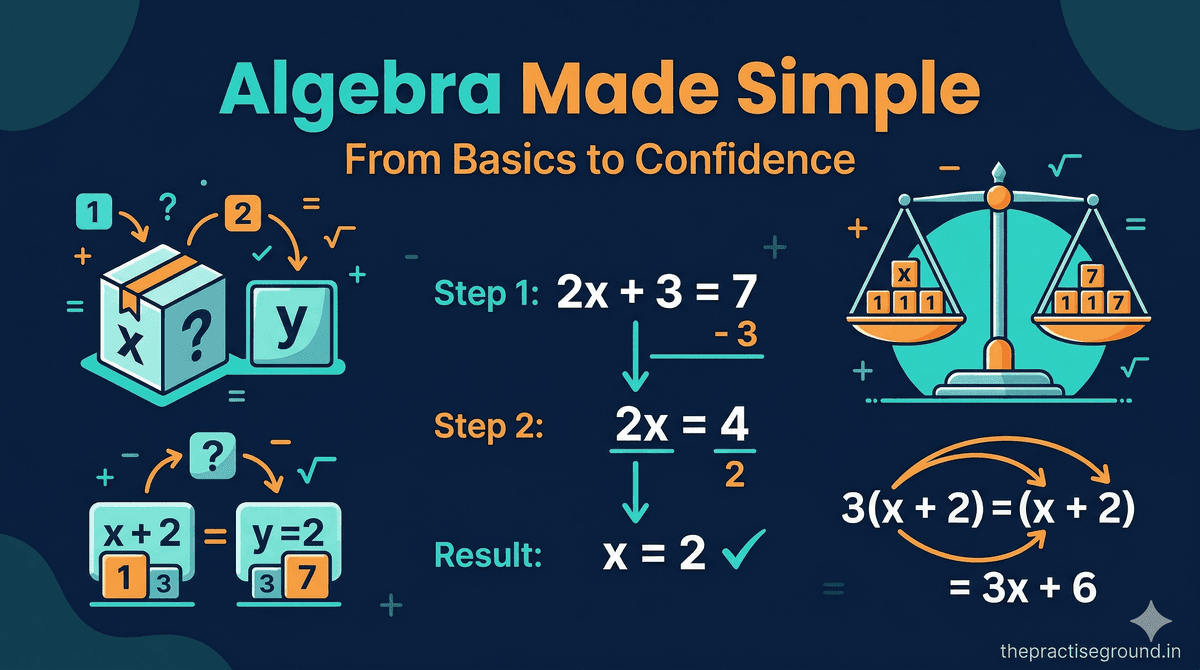
Many students see algebra as a sudden jump into difficult, abstract maths. But here's the truth: algebra is just arithmetic with unknowns. It's a tool for solving problems when you don't know all the information upfront.
Let's demystify algebra together and build your confidence from the ground up.
What is Algebra, Really?
Algebra is a way of expressing problems using letters (variables) to represent unknown numbers. Instead of saying "I think of a number, double it, and get 20," we write: 2x = 20
That's it. Algebra is just a more efficient way to represent and solve problems.
Why Do We Need Variables?
Scenario 1: A shopkeeper sells notebooks for Rs. 15 each. How much does she earn if she sells x notebooks?- Answer: 15x rupees
Without variables, these problems are hard to generalize. With variables, we can solve an entire class of similar problems with one equation.
The Language of Algebra
Variable: A letter representing an unknown number (x, y, a, b, etc.) Constant: A number that doesn't change (5, -3, 15, etc.) Coefficient: The number multiplying a variable. In 3x, the coefficient is 3. Expression: A combination of variables, constants, and operations. Examples: 2x + 5, x² - 3x + 2 Equation: An expression with an equals sign, showing two equal quantities. Examples: 2x = 10, x + 5 = 12 Term: Each part of an expression separated by + or -. In 3x + 2y - 5, the terms are 3x, 2y, and -5Algebraic Expressions: Breaking Them Down
Expression: 4x + 3y - 7
If x = 2 and y = 3: 4(2) + 3(3) - 7 = 8 + 9 - 7 = 10
Simplifying Expressions
Like terms are terms with the same variable raised to the same power.Simplify: 3x + 5y + 2x - 3y
This is like collecting similar objects: you group pens with pens and pencils with pencils.
Solving Linear Equations
The Goal: Find the value of the unknown variable. Golden Rule: Whatever you do to one side of the equation, do to the other side.Example 1: x + 5 = 12
Example 2: 3x = 15
Example 3: 2x - 3 = 7
Example 4: (x - 2)/3 = 4
Verification: Checking Your Answer
Always check your solution by substituting back:
If we solved 2x - 3 = 7 and got x = 5:
This check ensures you made no calculation errors.
Real-World Algebra
Problem: Ravi buys a pen and a notebook. The pen costs Rs. 8. The notebook costs Rs. 15 more than the pen. What's the total cost?Let's use variables:
Common Mistakes in Algebra
Mistake 1: Not applying the same operation to both sidesAlgebra in Different Curricula
The fundamentals remain the same across all curricula—master them well!
Practice on The Practise Ground
Building algebra confidence comes from solving varied problems. Our Grade 7-9 quizzes include:
Start practicing today and watch your algebra confidence grow!
FAQ
Why do we use x for the unknown? Why not other letters?
Historically, x was used in European algebra texts. Today, any letter works—we use y, z, a, b, etc. x is just convention!
How do I know if I set up the equation correctly for a word problem?
Re-read the problem slowly. Identify what you know and what you're looking for. Use a variable for the unknown. Check that your equation matches the problem statement.
Is there a trick to solving equations faster?
Yes—practice! With repetition, you'll recognize patterns. But more importantly, work carefully. A mistake early cascades, so accuracy beats speed.
When will I use algebra in real life?
Constantly! From calculating loans and budgets to coding, physics, engineering, and data science. Algebra is the foundation of problem-solving in the modern world.
Taking a quick break? Test yourself!
Pause and try a quick Grade 7 Maths quiz — see how much you've picked up so far.