
Want to test what you know?
Try our free Grade 8 English quiz — 25 questions, instant results, no sign-up.
Voice is one of the most important grammar topics in school and standardized exams worldwide. Questions on voice change appear regularly in CBSE, ICSE, Cambridge, and other English exams. Let's understand active and passive voice with clear rules and plenty of examples.
What is Active Voice?
In Active Voice, the subject (doer) of the action performs the verb. The action is active and direct.
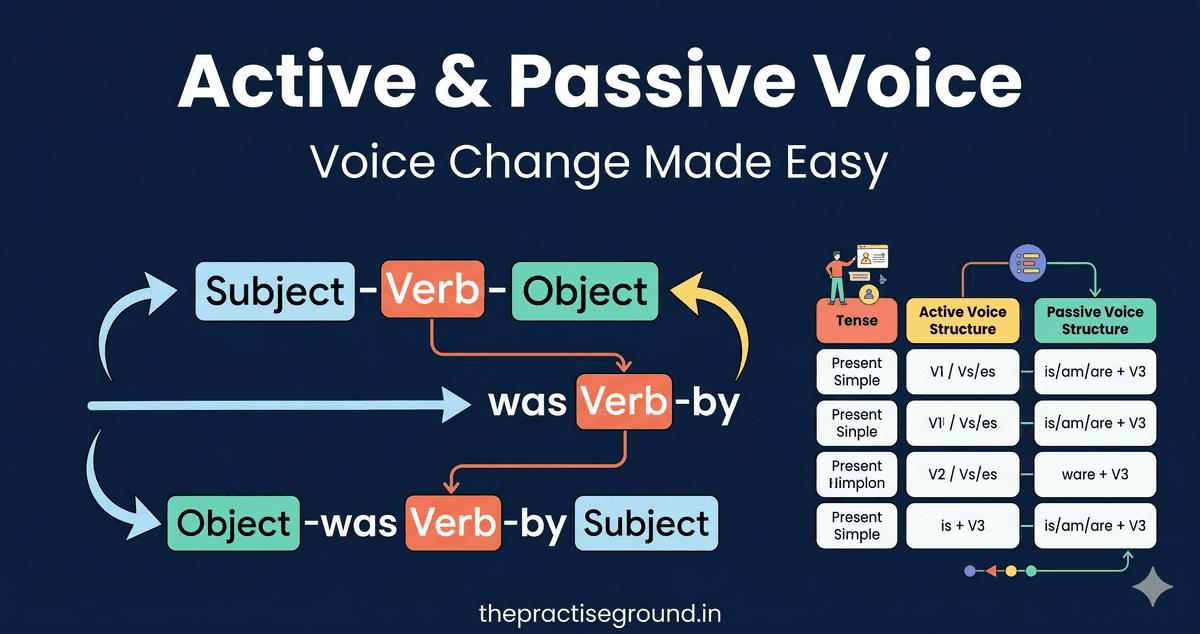
Formula: Subject + Verb + Object Examples:- Rahul wrote a letter.
- The teacher explained the lesson.
- The children are playing cricket.
- Emma completed her project.
- Scientists discovered a new element.
What is Passive Voice?
In Passive Voice, the object becomes the subject. The emphasis is on the action or the receiver of the action, not the doer.
Formula: Subject + Helping Verb + Past Participle + by + Agent Examples:The receiver of the action becomes the subject.
Why Use Passive Voice?
You might wonder: if active voice is simpler, why use passive voice? Here are real reasons, recognized across CBSE, ICSE, Cambridge, and IB curricula:
- When the doer is unknown: "The window was broken." (We don't know who broke it)
- When the doer is unimportant: "The exam has been postponed." (Who postponed it doesn't matter)
- For formality: "It is requested that students submit assignments on time." (More formal)
- To shift focus: "The Taj Mahal was built in 1632" focuses on the monument. "Big Ben was constructed in London" emphasizes the landmark.
How to Change Active to Passive
Step-by-Step Process
Step 1: Identify the object in the active sentence (this becomes the new subject) Step 2: Move the original subject after "by" Step 3: Change the verb to past participle Step 4: Add appropriate helping verbs (is, was, are, were, etc.)Example Transformations
Simple Present:When NOT to Change to Passive
Some sentences cannot be converted to passive voice:
Important Rules for Voice Change
Rule 1: Object Placement
The object of the active verb becomes the subject of the passive verb.Rule 2: Helping Verbs
Add "is," "am," "are," "was," "were," "be," "being," or "been" depending on the tense.Rule 3: Past Participle
The main verb changes to its past participle form.Rule 4: Subject Placement
The active subject comes after "by" (the agent), or is omitted if unimportant.Common Mistakes in Voice Change
Mistake 1: Forgetting the helping verbFAQ: Voice Questions from Exams
Do we always include "by" in passive voice?
Not always. If the agent is unknown or unimportant, we omit "by + agent." Example: "This book was published in 2020."
How do I know which tense to use in passive voice?
The tense remains the same! If it's past simple in active, it's past simple in passive. Only the helping verb changes.
Can all verbs be made passive?
No. Intransitive verbs (verbs that don't take an object) cannot be made passive. Examples: go, come, sit, laugh.
How is passive voice tested in different curricula?
CBSE emphasizes transformation, ICSE focuses on recognition and usage, Cambridge assesses practical application, and IB demands nuanced understanding across registers.
Practice Exercises
Try converting these sentences from active to passive:
Master Voice Change with Practice
Understanding active and passive voice is crucial for exam success. Practice regularly to strengthen your skills.
Conclusion
Active and passive voice are tools for expressing the same idea in different ways. Master the transformation rules, practice regularly, and voice change questions will become easy. Remember: the object becomes the subject, the subject becomes the agent (or is omitted), and the verb becomes a past participle with appropriate helping verbs.
Start practicing today and watch your grammar confidence grow!
Taking a quick break? Test yourself!
Pause and try a quick Grade 8 English quiz — see how much you've picked up so far.