Want to test what you know?
Try our free Grade 5 English quiz — 25 questions, instant results, no sign-up.
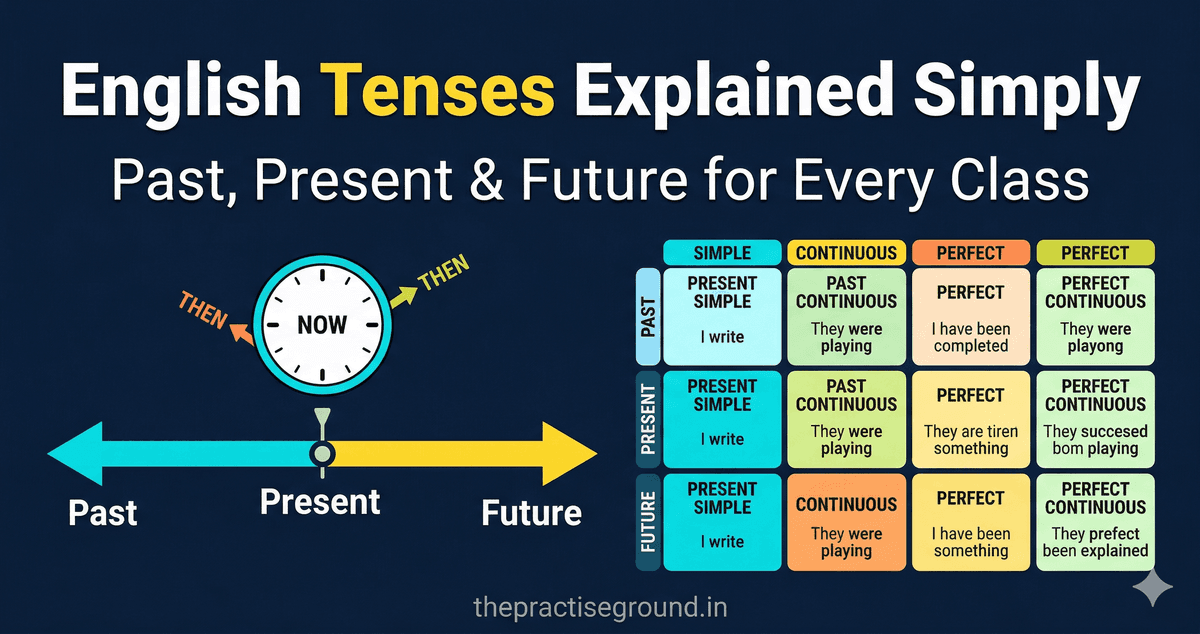
Understanding tenses is crucial for writing and speaking English correctly. Students in India and around the world struggle with tenses because they seem complicated, but once you understand the basic structure, they become much easier. Let's break down all the tenses you need for CBSE, ICSE, Cambridge, and IB exams, plus competitive tests worldwide.
What Are Tenses?
A tense tells us when an action happens—in the past, present, or future. English has 12 main tenses, but don't worry! They follow a logical pattern once you understand the basics.
The Three Main Time Frames
- Present Tense – What is happening now
- Past Tense – What happened before
- Future Tense – What will happen later
Simple Present Tense
The Simple Present tells us about facts, routines, and general truths.
Formula: Subject + Base Verb (+ s/es for third person) Examples:Simple Past Tense
The Simple Past tells us about completed actions in the past.
Formula: Subject + Verb in past form (usually + ed) Examples:Simple Future Tense
The Simple Future tells us about actions that will happen later.
Formula: Subject + Will + Base Verb Examples:Present Continuous Tense
The Present Continuous tells us what is happening right now, at this moment.
Formula: Subject + am/is/are + Verb + ing Examples:Past Continuous Tense
The Past Continuous tells us what was happening at a specific time in the past.
Formula: Subject + was/were + Verb + ing Examples:Future Continuous Tense
The Future Continuous tells us what will be happening at a future time.
Formula: Subject + will be + Verb + ing Examples:Present Perfect Tense
The Present Perfect connects the past with the present. The action happened in the past, but it affects the present.
Formula: Subject + has/have + Verb (past participle) Examples:Perfect Practice Tip
The hardest part for students learning English is remembering which helping verb to use (has vs. have). Remember: Use "has" for third person singular (he, she, it), and "have" for everything else.
Common Mistakes to Avoid
FAQ: Tenses Questions Students Ask
When do I use Present Perfect vs. Simple Past?
Use Present Perfect when the action's result matters now ("I have finished my homework, so I can play"). Use Simple Past for completed actions ("I finished my homework yesterday"). This distinction is important in CBSE, ICSE, Cambridge, and IB exams.
Is "will" the only way to talk about the future?
No! You can also use "going to" ("I am going to study") or Present Continuous ("I am studying tonight"). But "will" is most common for formal exams globally.
Why do we need so many tenses?
Different tenses help us express different meanings. English tenses let us be precise about time and duration, whether you're writing for CBSE exams in India or Cambridge assessments in the UK.
Understanding Tenses Across Curricula
Tenses are fundamental to all English curricula worldwide:
Practice These Tenses
Master tenses by practicing with our free English quizzes. Regular practice is the secret to mastering tenses across all exam boards!
Conclusion
Tenses might seem complex at first, but they follow logical patterns. Practice using them in sentences, and soon they'll become second nature. Remember, most exams—whether CBSE in India, Cambridge internationally, or IB globally—test your understanding of Simple, Continuous, and Perfect tenses. Focus on these three, and you'll ace your grammar sections!
Ready to test your knowledge? Try our English quizzes and track your progress. The tense concepts you master today will serve you throughout your academic career worldwide!
Taking a quick break? Test yourself!
Pause and try a quick Grade 5 English quiz — see how much you've picked up so far.