
Want to test what you know?
Try our free Grade 6 Maths quiz — 25 questions, instant results, no sign-up.
Close your eyes and look around. The room you're in is full of geometry: rectangular walls, circular light bulbs, triangular roof trusses. Geometry is the mathematics of space and shape—and it's everywhere.
In this guide, we'll explore the essential concepts that form the foundation of this powerful branch of mathematics.
What is Geometry?
Geometry comes from Greek words meaning "Earth measurement." It's the study of shapes, sizes, and positions of objects in space. Unlike algebra, which deals with numbers and equations, geometry deals with visual space and spatial relationships.
Basic Building Blocks
Points
A point has no dimension—just location. We name it with a capital letter: A, B, C.Lines
A line is a straight path extending infinitely in both directions. We name it by two points on it: line AB or use lowercase letters: line l.Line Segments
A line segment has two endpoints and a fixed length. Named: segment AB or AB.Rays
A ray starts at a point and extends infinitely in one direction. Named: ray AB (starts at A, goes through B).Angles
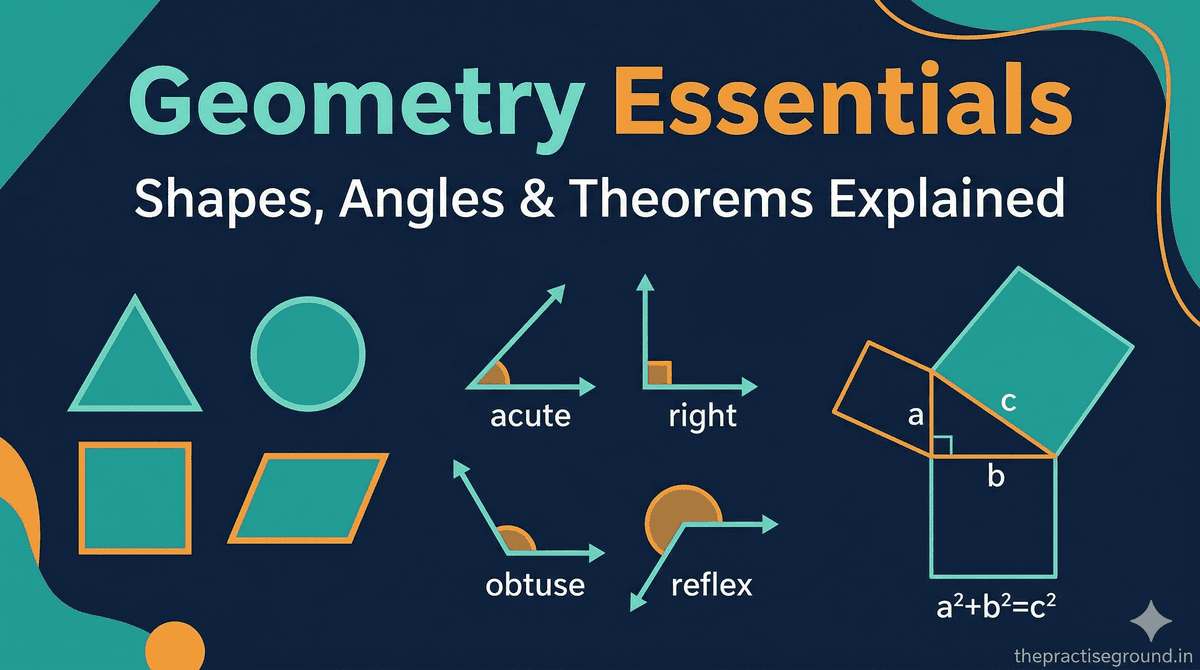
An angle is formed by two rays sharing a common endpoint (vertex). Angle Measurement:- Acute angle: 0° to 90°
- Right angle: exactly 90°
- Obtuse angle: 90° to 180°
- Straight angle: 180°
- Reflex angle: 180° to 360°
Angle Relationships
Complementary Angles
Two angles that add up to 90°Supplementary Angles
Two angles that add up to 180°Vertically Opposite Angles
When two lines intersect, opposite angles are equal. CODEBLOCK0Triangles: The Foundation of Geometry
Types by Angles
Types by Sides
Angle Sum Property
The sum of all angles in any triangle = 180°If you know two angles, you can always find the third:
The Pythagorean Theorem
One of the most important discoveries in mathematics: In any right-angled triangle, the square of the hypotenuse equals the sum of squares of the other two sides.
a² + b² = c²where c is the hypotenuse (longest side, opposite the right angle).
Classic Example: 3-4-5 Triangle
Real-World Application
You're building a bookshelf against a wall. You want the shelf 2 meters high and 1.5 meters away from the wall. What length brace do you need?Other Pythagorean Triples
These are useful in competitive exams and real-world calculations!
Quadrilaterals
Rectangle
Square
Parallelogram
Rhombus
Trapezoid
Key Properties in Triangles
Angle Bisector
A line that divides an angle into two equal parts.Perpendicular Bisector
A line perpendicular to a side passing through its midpoint.Median
A line from a vertex to the midpoint of the opposite side.Altitude
A perpendicular line from a vertex to the opposite side.In an equilateral triangle, all four of these are the same line!
Circle Properties
Essential Terms
Chord, Arc, Sector
Congruent and Similar Figures
Congruent Figures
Figures with identical shape and size. All corresponding sides and angles are equal. Symbol: ≅Similar Figures
Figures with the same shape but different sizes. Corresponding angles are equal; corresponding sides are proportional.Why It Matters
If two triangles are similar, you can use known measurements from one to find unknown measurements in the other—powerful for real-world applications!Geometry in Real Life
Architecture: Buildings use geometry for structural integrity. The Eiffel Tower uses triangles extensively because they're rigid and strong. Design: Logos, patterns, and artistic compositions rely on geometric principles and symmetry. Navigation: Maps use coordinate geometry. GPS coordinates define position using geometric principles. Engineering: Bridge design, road construction, and machinery all depend on geometric calculations. Nature: Honeycombs (hexagons), snowflakes (6-fold symmetry), spiral shells (logarithmic spirals)—nature is deeply geometric!Practice on The Practise Ground
Geometry becomes intuitive through practice with visual problems. Our Grade 6-9 quizzes include:
Master geometry through interactive practice!
FAQ
Is there a shortcut to remembering all these properties?
Understanding the properties beats memorization. Draw and manipulate shapes yourself. Understanding builds confidence and retention.
How are CBSE and ICSE geometry different?
Both cover similar topics (triangles, circles, quadrilaterals, theorems). ICSE sometimes emphasizes applications more. The fundamentals are universal across Cambridge and IB too.
Why is Pythagoras theorem so important?
It's foundational! It connects to trigonometry, calculus, physics, and engineering. Mastering it now saves you countless headaches later.
Can I use a calculator for geometry?
It's helpful for calculations, but geometry is about understanding relationships. Always draw diagrams and understand why formulas work.
Taking a quick break? Test yourself!
Pause and try a quick Grade 6 Maths quiz — see how much you've picked up so far.